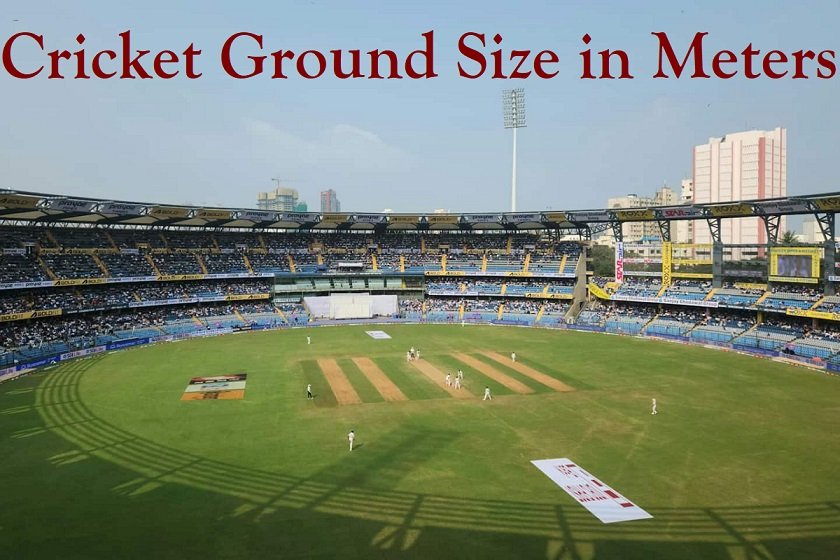

Cricket Ground Size in Meters
Cricket is one of the most famous sports within the international, specially in international locations like India, England, Australia, and Pakistan. While fans often attention on gamers, ratings, and facts, one vital aspect of the game is often ignored — the cricket ground size. Understanding the Cricket Ground Size in Meters is vital for players, coaches, floor staff, or even cricket lovers who want deeper information of the game.
Unlike soccer or athletics, cricket does no longer have a fixed ground size. Instead, the International Cricket Council (ICC) presents a range of authorized dimensions within which a cricket ground have to fall. This flexibility allows cricket to be performed in extraordinary countries, terrains, and stadium designs at the same time as preserving equity and stability.
Table of Contents
In this detailed manual, we are able to give an explanation for the Cricket Ground Size in Meters, boundary regulations, pitch dimensions, fielding circle measurements, and how floor sizes vary throughout codecs like Test, ODI, and T20 cricket.
Is There a Fixed Cricket Ground Size?
No, cricket does not have a single fixed floor length. According to ICC laws, a cricket ground should be big enough to make certain protection and fairness, but its exact form and length can vary.
However, the boundary distance must stay within a specific variety, measured from the center of the pitch. These measurements are described in meters to make certain worldwide consistency.
Official Cricket Ground Size in Meters (As per ICC)
The boundary size is the most essential dimension whilst discussing cricket floor length.
Minimum and Maximum Boundary Distance
- Minimum boundary distance: 59.43 meters
- Maximum boundary distance: 82.29 meters
These measurements are taken from the center of the pitch to the boundary rope.
Key ICC Rule
No boundary have to be less than 59.43 meters, and no more than 82.29 meters, unless accepted beneath extraordinary instances.
Cricket Ground Boundary Size Table
| Measurement Type | Size in Meters |
|---|---|
| Minimum Boundary Distance | 59.43 m |
| Maximum Boundary Distance | 82.29 m |
| Recommended Straight Boundary | 64–75 m |
| Recommended Square Boundary | 65–80 m |
Shape of a Cricket Ground
Cricket grounds are normally:
- Circular
- Oval
- Slightly elliptical
The form relies upon on land availability and stadium design. Unlike rectangular sports fields, cricket grounds are designed to permit 360-degree play, that’s why dimensions range.
Cricket Pitch Size in Meters
The pitch is the critical strip wherein bowling and batting arise. Unlike the floor, the pitch has fixed dimensions.
Standard Cricket Pitch Dimensions
| Pitch Measurement | Size |
|---|---|
| Pitch Length | 20.12 meters |
| Pitch Width | 3.05 meters |
| Protected Area Width | 3.05 meters |
| Bowling Crease Length | 2.64 meters |
The pitch stays the same across Test, ODI, and T20 cricket.
Cricket Ground Size for International Matches
Test Match Grounds
Test cricket grounds are normally larger, permitting greater space for discipline placement and staying power-based play.
- Boundary distance frequently in the direction of 75–80 meters
- Larger square boundaries
- Designed for lengthy-period fits
ODI Cricket Grounds
ODI grounds balance scoring and competitiveness.
- Boundary distance generally 65–75 meters
- Medium-sized playing region
- Suitable for each batters and bowlers
T20 Cricket Grounds
T20 cricket is designed for leisure and high scoring.
- Boundary distance regularly close to the minimal limit (59–65 meters)
- Smaller grounds encourage more sixes
- Faster-paced gameplay
Comparison Table: Ground Size by using Format
| Format | Typical Boundary Size (Meters) | Ground Nature |
|---|---|---|
| Test Cricket | 70–82 m | Large, traditional |
| ODI Cricket | 65–75 m | Balanced |
| T20 Cricket | 59–70 m | Smaller, batting-friendly |
Fielding Circle Size in Meters
The fielding circle performs a critical role in contemporary cricket, in particular in confined-overs codecs.
Inner Fielding Circle
- Radius: 27.43 meters from the middle of the pitch
- At least 4 fielders have to be internal in the course of powerplay
Outer Circle (30-Yard Circle)
- Radius: 27.43 meters (30 yards)
- Used to restrict area placements
Fielding Circle Measurement Table
| Fielding Area | Radius in Meters |
|---|---|
| Inner Circle | 27.43 m |
| 30-Yard Circle | 27.43 m |
| Powerplay Fielders Outside | Limited |
Boundary Rope and Advertising Area
- Boundary rope have to be within the real fence
- Rope distance guarantees player safety
- Advertising forums ought to now not interfere with play
The boundary rope is flexible and altered to satisfy ICC minimal distance regulations.
Why Cricket Ground Size Varies
Several factors impact cricket ground size:
- Land availability
- Stadium structure
- City planning
- Audience potential
- Match format
For example, older stadiums in England tend to be smaller, at the same time as Australian grounds are famously big.
Famous Cricket Grounds and Their Approximate Sizes
| Cricket Ground | Country | Approx. Boundary Size |
|---|---|---|
| Melbourne Cricket Ground (MCG) | Australia | 75–85 m |
| Eden Gardens | India | 65–75 m |
| Lord’s Cricket Ground | England | 60–75 m |
| Narendra Modi Stadium | India | 70–80 m |
| SCG | Australia | 65–75 m |
Smallest and Largest Cricket Grounds
Smallest Grounds
- Sharjah Cricket Stadium
- Short square barriers
- Around 59–62 meters
Largest Grounds
- MCG
- Some South African stadiums
- Boundaries near 80+ meters
Impact of Ground Size on the Game
Batting
- Smaller grounds = greater sixes
- Larger grounds = extra going for walks among wickets
Bowling
- Bigger grounds want spinners and speedy bowlers
- Smaller grounds require shielding bowling
Fielding
- Larger grounds demand athletic fielders
- More catching opportunities in large stadiums
Safety Rules Related to Ground Size
ICC guarantees:
- Safe distance between boundary and fence
- No tough objects near gambling region
- Proper cushioning near advertising and marketing boards
These regulations protect gamers at some point of dives and boundary saves.
Cricket Ground Size for Local and Domestic Matches
Domestic and local suits may additionally have:
- Slightly shorter barriers
- Flexible dimensions
- Relaxed policies as compared to global cricket
However, professional tournaments nonetheless try and observe ICC recommendations.
Frequently Asked Questions (FAQs)
What is the minimal cricket ground size in meters?
The minimal boundary distance is 59.43 meters from the center of the pitch.
Is cricket ground size same anywhere?
No, cricket floor length varies, but it must comply with ICC minimum and most limits.
Is pitch size constantly the same?
Yes, the pitch length is continually 20.12 meters long and 3.05 meters huge.
Which format makes use of the smallest grounds?
T20 cricket commonly makes use of smaller grounds to boom entertainment.
Conclusion
Understanding the cricket ground size in meters offers deeper perception into how the game is played and regulated. While cricket grounds do now not have a hard and fast size, ICC regulations ensure equity via defining minimal and maximum boundary distances. From massive stadiums just like the MCG to compact grounds like Sharjah, every ground adds a completely unique man or woman to the game.
Whether you’re a player, train, pupil, or cricket fan, understanding those measurements facilitates you appreciate the strategic intensity of cricket. From pitch dimensions to boundary lengths and fielding circles, every meter performs a function in shaping the final results of a healthy.


