
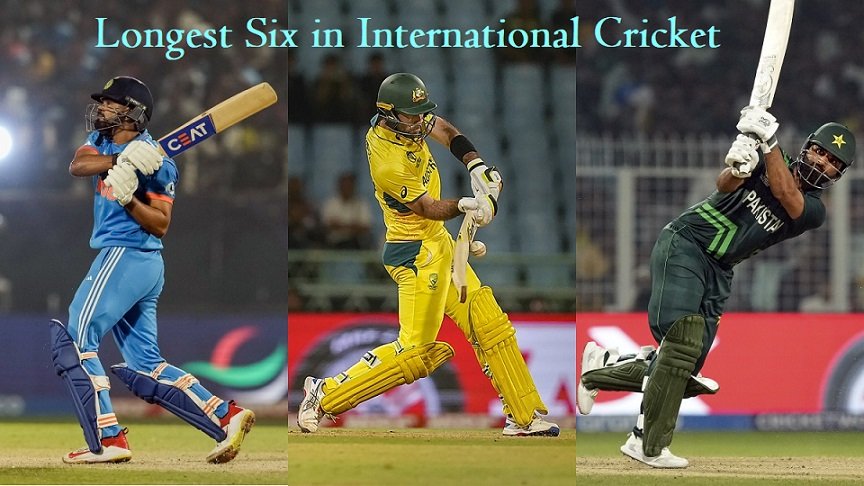

Longest Six in International Cricket
The longest six in international cricket is one of the most fascinating topics for cricket fans. A perfectly timed six can travel properly beyond the boundary, occasionally clearing stands and even leaving the stadium. Over the years, effective hitters such as Shahid Afridi, Brett Lee, Martin Guptill, Corey Anderson, Yuvraj Singh and Liam Livingstone have produced high-quality sixes.
However, there may be a vital point to recognize before discussing the report. Unlike statistics, which include runs, wickets and centuries, there may be no universally maintained, authentic ICC report for the longest six ever hit in worldwide cricket. Historically, six distances had been now not usually measured using standardized equipment, and figures mentioned by broadcasters or media can fluctuate.
Shahid Afridi is nevertheless extensively related to the longest six in worldwide cricket. His big hit against South Africa in Johannesburg in 2013 is typically said to be 153 meters, while some articles and social-media posts have claimed 158 meters. A designated researcher via The Cricket Monthly questioned the 158-metre claim and suggested that the shot’s horizontal distance was closer to 120 metres.
Therefore, the most accurate way to describe Afridi’s success is that his famous six is extensively stated as about 153 metres, rather than presenting 158 metres as an undisputed, authentic global record.
Shahid Afridi and the Famous 153-Metre Six
Pakistan’s legendary all-rounder Shahid Afridi became well-known for his competitive batting and brilliant ability to clear the boundary. His nickname, “Boom Boom,” reflected his explosive style.
During Pakistan’s ODI against South Africa at the Wanderers Stadium in Johannesburg in 2013, Afridi struck a massive six towards Ryan McLaren. The shot became one of the most famous long sixes in international cricket.
Many cricket websites and media reports have indexed the distance as 153 metres. Some popular sources have, as a substitute, said 158 metres. However, unbiased evaluation has cast doubt on the larger figure. The Cricket Monthly used geographical measurements to suggest that the ball could not have travelled the claimed 158 metres horizontally and estimated the gap at no greater than more or less one hundred twenty metres.
This demonstrates why the phrase “longest six in worldwide cricket” needs to be used carefully. The Afridi shot is famous and fantastically lengthy; however, the actual dimension is disputed.
Longest Six in International Cricket: Important Records
Here is a beneficial evaluation of some of the largest sixes usually reported in worldwide cricket:
| Rank / Category | Player | Approx. Distance | Opponent | Year | Important Note |
|---|---|---|---|---|---|
| Famous longest claim | Shahid Afridi | 153 m reported | South Africa | 2013 | Distance is disputed |
| Huge six | Brett Lee | 135–143 m reported | West Indies | 2005 | Exact distance varies by source |
| Major international six | Martin Guptill | 127 m reported | South Africa | 2012 | One of the most frequently cited long hits |
| Long six | Corey Anderson | 122 m reported | India | 2014 | Famous for enormous power |
| T20 World Cup six | Yuvraj Singh | 119 m reported | Australia | 2007 | Hit in the semifinal |
| T20I six | Liam Livingstone | 122 m | Pakistan | 2021 | Officially reported match highlight |
| T20I six | Tim David | 129 m | India | 2025 | Reported as a record-setting T20I hit |
The figures above need no longer all be treated as directly similar legitimate measurements. Historical distances specially range among sources. For instance, Brett Lee’s famous Gabba six has been stated at extraordinary distances, whilst contemporary broadcast measurements are typically simpler to record.
Brett Lee’s Massive Six
Australia’s Brett Lee is in general remembered as one of the fastest bowlers in international cricket; however, he may also hit the ball extraordinarily hard.
During a Test match against the West Indies on the Gabba in 2005, Lee struck a massive six. It has commonly been stated at about a hundred 35 metres, at the same time as some lists have put it as high as 143 metres.
The shot is especially memorable due to the fact that Lee became a fast bowler in place of an expert, electricity-hitting batter. His electricity and aggressive method allowed him to generate super bat pace.
The suggested distance is another instance of why historical six records want to be treated with caution. Different sources have published different numbers for the equal shot.
Martin Guptill’s 127-Metre Six
New Zealand opener Martin Guptill is another well-known name whilst discussing the longest sixes in worldwide cricket.
Guptill was famed for easy ball putting, in particular via the leg side. A six against South Africa has often been indexed at about 127 metres.
His capability to generate vast energy without acting to overhit the ball made him one of the most risky white-ball batters of his generation.
Corey Anderson’s 122-Metre Six
New Zealand’s Corey Anderson additionally appears on many lists of the longest sixes. He turned into an incredibly strong left-handed hitter and could clear even big barriers.
His approximately 122-metre six against India in 2014 is regularly mentioned among the biggest international sixes. Like other historical distance figures, the ideal dimension ought to be considered approximate rather than a reliable standardized record.
Yuvraj Singh’s Famous 119-Metre Six
Indian fanatics will consider Yuvraj Singh for many surprising sixes, particularly his six sixes in an over against England within the 2007 ICC World Twenty20.
But Yuvraj also produced a large six at some stage in India’s semifinal against Australia in the identical tournament. The six was reported at about 119 metres.
Yuvraj’s six-hitting ability became a primary part of his reputation as certainly one of India’s most unfavourably constrained-overs batters.
Liam Livingstone’s 122-Metre T20I Six
England’s Liam Livingstone has evolved a reputation for big sixes in present-day white-ball cricket.
In a T20I against Pakistan in 2021, Livingstone struck a 122-metre six. The shot confirmed the excellent electricity that contemporary batters can generate with progressed fitness, approach and device.
Livingstone’s hitting is especially fantastic due to the fact that he can attack each tempo and spin and may clear the boundary from special positions within the crease.
Tim David’s 129-Metre T20I Six
Modern cricket has also produced a few enormous measured sixes.
During Australia’s T20I against India in Hobart in 2025, Tim David hit a measured 129-metre six off Axar Patel. The ball struck signage above the David Boon Stand, certainly one of the most important measured sixes visible in the latest worldwide T20 cricket.
This is essential as it demonstrates how cutting-edge broadcast technology is enhancing the documentation of big sixes.
Why Is It Difficult to Confirm the Longest Six?
There are several reasons why there is no easy, authentic listing of the longest six in worldwide cricket.
1. Old Matches Were Not Measured Using Modern Technology
Many well-known sixes were hit a long time in the past, when stadiums did not have superior ball-monitoring systems.
2. Different Measurement Methods
A broadcaster may estimate the distance from the point of impact to where the ball landed. Another source might calculate the gap using stadium dimensions or video footage.
3. Stadium Geometry
A six hit close to a stand, roof, or parking area may be tough to measure as it should be. The real trajectory of the ball is three-dimensional, while some estimates measure only horizontal distance.
4. Media Reports Can Repeat Incorrect Numbers
Once a large quantity, along with “158 metres,” becomes famous, different websites may additionally repeat it without independently checking the authentic size.
The Afridi instance is a good illustration. The 158-metre parent is extremely popular online, but impartial analysis has challenged it.
What Makes a Six Travel So Far?
The distance of a six depends on several elements.
Bat pace: Faster bat pace can transfer greater strength to the ball.
Ball speed: The velocity at which the ball arrives can contribute extensively to the final distance.
Launch angle: A powerful shot desires a appropriate release perspective. Too low and the ball travels quick however falls faster; too excessive and power is lost to excessive vertical movement.
Quality of touch: The sweet spot of the bat produces green strength switch.
Wind: A sturdy tailwind can help a ball travel drastically farther.
Altitude: Higher-altitude locations can lessen aerodynamic drag, probably helping the ball journey farther.
Stadium dimensions: The ball’s flight may additionally appear even more wonderful whilst it clears massive stands or leaves the stadium.
Longest Six vs Highest Six
The terms longest six and maximum six are from time to time confused.
A longest six means the ball travelled the greatest distance.
A maximum six refers to the greatest height reached by the ball.
These aren’t the same issue. A ball can journey a very long distance without reaching an exquisite peak, whilst some other shot can pass extremely high; however now not journey as far horizontally.
Therefore, whilst people search for the longest six in worldwide cricket, they may commonly be asking about the distance travelled in preference to the peak of the ball.
Why Shahid Afridi Remains Closely Associated With the Record
Despite the uncertainty surrounding the exact distance, Shahid Afridi remains the participant most commonly related to the longest six in international cricket.
His reputation turned into constructed round great power. Afridi often attacked bowlers and was willing to take risks that many batters avoided.
His well-known Johannesburg shot has become a part of cricket folklore. Whether the actual distance was 120, 153, or every other distance, there’s no question that it became a widespread hit.
The distinction between a stated record and an established, reliable report is essential while writing about cricket facts.
Top Players Famous for Massive Sixes
Several global cricketers have grown to be synonymous with six-hitting:
- Shahid Afridi – Famous for explosive power and substantial sixes.
- Brett Lee – A fast bowler who once in a while produced brilliant hits.
- Martin Guptill – One of New Zealand’s most powerful white-ball batters.
- Chris Gayle – Famous worldwide for towering sixes and destructive batting.
- Yuvraj Singh – One of India’s greatest restricted-overs six-hitters.
- MS Dhoni – Known for powerful finishing and lengthy direct hits.
- Corey Anderson – An effective left-handed hitter.
- Liam Livingstone – One of the current generation’s biggest hitters.
- Tim David – Known for brilliant strength in T20 cricket.
Is 158 Metres Really the Longest Six in International Cricket?
The answer calls for a qualification.
Shahid Afridi’s 158-metre six is broadly claimed online; however, it must no longer be presented as an undisputed, reputable global cricket document.
Several sources instead describe the well-known Johannesburg hit as about 153 metres, even as unique analysis has puzzled even that distance.
Consequently, a factually accountable article must say that Afridi’s 2013 six is widely appeared or pronounced as one of the longest—and often defined as the longest; however, there may be no universally accepted reputable international document for the longest six.
Conclusion
The longest six in international cricket is a charming record, but it is also a statistic that requires cautious explanation. Shahid Afridi’s big 2013 six towards South Africa is the name most frequently linked with the record, with many resources reporting approximately 153 metres and others repeating the disputed 158-metre figure.
Brett Lee, Martin Guptill, Corey Anderson, Yuvraj Singh, Liam Livingstone and Tim David have also produced exquisite sixes, with several exceeding a hundred and twenty metres in line with usually reported measurements.



Show Comments